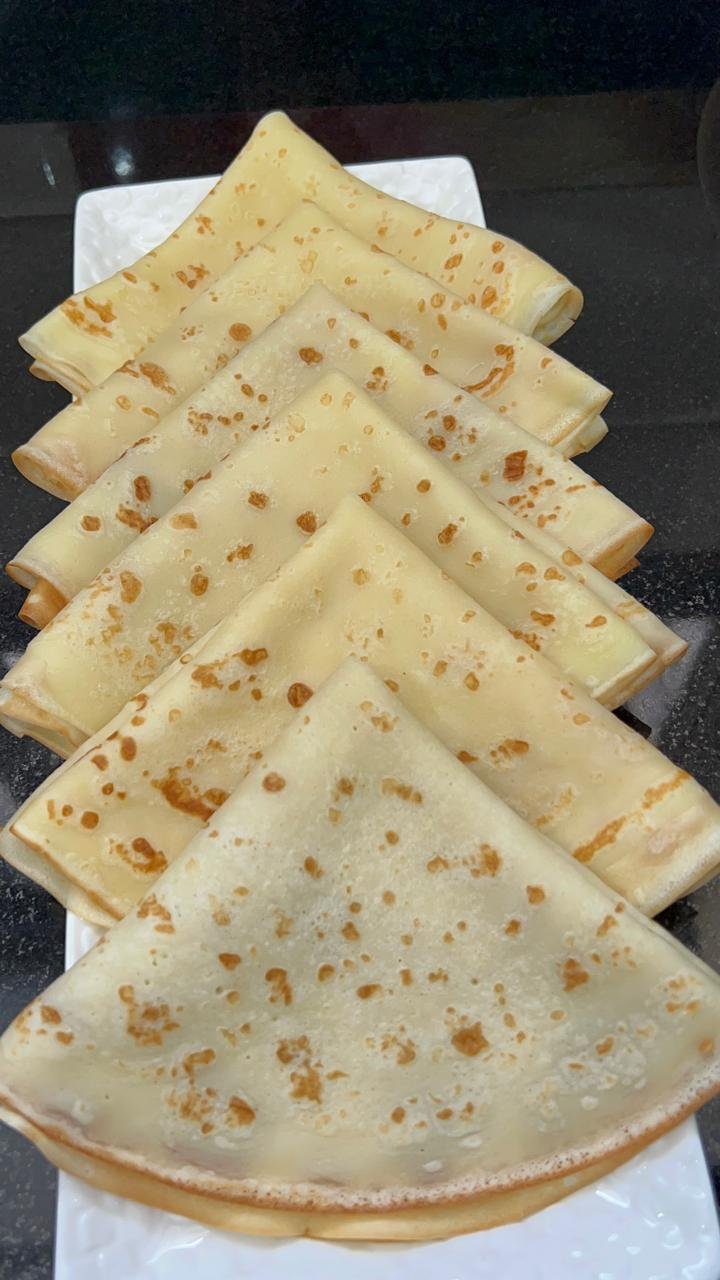
Ingredients
Method
- In a large bowl, whisk together the eggs, salt, sugar and vanilla extract until the sugar begins to dissolve.
- Pour in the buttermilk and water and whisk until fully combined. The batter will look thin, which is correct.
- Add the flour gradually, whisking to avoid lumps. For the smoothest batter, blend it in a mixer or blender for a few seconds.
- Stir in the cooled melted butter until the batter is uniform.
- Let the batter rest for 15 minutes so the flour hydrates and the gluten relaxes.
- Heat a non-stick skillet over medium heat. Pour in a ladleful of batter and immediately swirl the pan to coat the bottom in a thin even layer.
- Cook for 1 to 2 minutes until the edges lift and the bottom is golden, then flip and cook the other side briefly.
- Stack the finished crepes on a plate to keep them warm and soft. Repeat for all 8 crepes.
Notes
Blend the batter in a mixer or blender for a few seconds for a completely lump-free result.
Rest the batter at least 15 minutes. Skipping this is the main reason crepes turn out rubbery.
The first crepe is a test while the pan finds its temperature. Adjust the heat and keep going.
No buttermilk? Add 1 tablespoon of lemon juice or vinegar to 2 cups of milk and let it sit 5 minutes.
The batter can be made a day ahead and kept in the fridge, which makes the crepes even more tender.
Rest the batter at least 15 minutes. Skipping this is the main reason crepes turn out rubbery.
The first crepe is a test while the pan finds its temperature. Adjust the heat and keep going.
No buttermilk? Add 1 tablespoon of lemon juice or vinegar to 2 cups of milk and let it sit 5 minutes.
The batter can be made a day ahead and kept in the fridge, which makes the crepes even more tender.